How to choose the right AC drive: a 7-step checklist
Size a frequency converter by motor current, overload, voltage, enclosure, EMC class and options – a practical checklist for Danfoss VLT®, VACON® and iC7 drives.
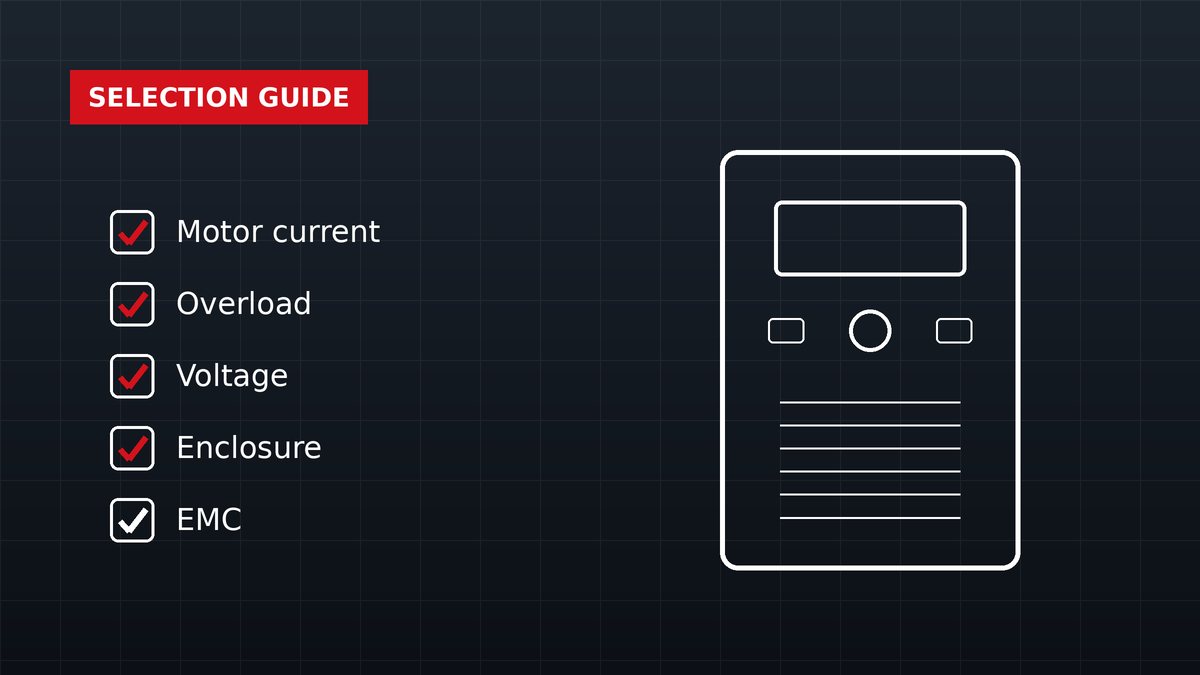
Choosing a frequency converter is mostly about matching the drive to the motor, the load and the installation site. Get these seven points right and the model code almost writes itself.
1. Start with the motor current, not only the kW
The kW on the motor nameplate is a good first filter, but the drive must deliver the motor’s full-load current at your mains voltage. Motors with many poles, older motors and special motors often draw more current than a standard 4-pole motor of the same power. Always compare the motor nameplate current with the drive’s continuous output current – you’ll find it in the technical data of every product page.
2. Decide on normal or high overload
Pumps and fans (variable torque) usually need a normal overload rating. Conveyors, mixers, crushers, hoists and other constant-torque loads usually need a high overload rating, which often means choosing one power size larger. Many Danfoss drives state both ratings – check which one matches your application.
3. Match the mains voltage and phases
Drives are built for a voltage range, for example 200–240 V, 380–480 V, 380–500 V or 525–690 V. Pick the range that includes your supply, and check whether the drive accepts single-phase input if that’s all you have available.
4. Choose the enclosure for the installation site
An IP20 or IP00 drive belongs inside a cabinet. For wall mounting in a plant room, IP21/UL Type 1 or IP54/IP55 is typical. Wash-down or outdoor areas call for IP66. Our guide to IP ratings, RFI filters and brake choppers explains the differences.
5. Select the RFI filter for your EMC environment
Residential and commercial buildings (the first environment) need a stricter filter than an industrial plant (the second environment). The RFI filter class in the model code tells you which EMC category the drive meets.
6. Braking, safety and control options
- Brake chopper – needed when the load must stop quickly or regenerates energy, for example hoists, centrifuges and high-inertia fans.
- Safe Torque Off (STO) – for machine safety functions.
- Fieldbus – PROFINET, EtherNet/IP, Modbus TCP, PROFIBUS and others.
- Control panel – graphical or numerical local control panel, or none if the drive is controlled remotely.
7. Pick the product family
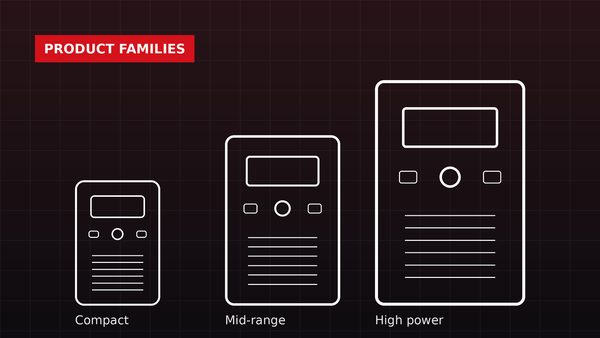
Finally, choose the family that fits the application – HVAC, water and wastewater, refrigeration or general industrial automation. See VLT®, VACON® or iC7? A guide to the Danfoss drive families.
Not sure? Send us the motor nameplate
A photo of the motor nameplate plus a short description of the application is often enough for us to propose the right drive. Use the Request a quote button on any page, or start from the Low Voltage Drives overview and use the filters for power, voltage, IP rating and options.